
Law School Overview

Choosing a field of law is a gradual process, and students do not need to make this decision before entering law school. The overview below highlights common practice areas, the types of work lawyers perform in each, and typical professional settings. These descriptions can serve as starting points for informational interviews, internships, and coursework that help students confirm areas of interest or eliminate those that may not be the right fit.
Students can visit the LSAC website to learn more about common fields of law that may be of interest.
Experiences & Skills
Preparing for law school involves more than earning strong grades. Admissions committees look closely at how intentionally students develop core skills such as critical thinking, problem solving, analytical writing, oral communication, and research skills. Meaningful and sustained involvement in activities helps students strengthen these abilities and demonstrate maturity and readiness for professional study. By engaging with a variety of experiences and reflecting on the growth that occurs, students build a strong foundation for success in law school and in their future legal careers.
Core Experience Categories
Involvement in a service activity without compensation.
Examples:
- Assisting with client intake, document sorting, or front‑desk support at legal aid offices.
- Volunteering in community legal clinics that provide guidance on housing, immigration, or consumer issues.
- Supporting courthouse staff by helping visitors navigate forms, locations, or procedural questions.
- Assisting public defender or state attorney offices with case file organization or administrative tasks.
- Helping nonprofit advocacy groups with outreach, community education, or rights‑awareness events.
- Volunteering with youth courts or diversion programs focused on restorative practices.
- Supporting voter‑rights organizations with registration drives, nonpartisan election assistance, or community outreach.
- Helping immigration resource centers with translation, documentation support, or citizenship preparation.
- Assisting mediation or conflict‑resolution centers with scheduling, case intake, or community outreach.
- Participating in campus or community events related to civic engagement, constitutional education, or public policy awareness.
Legal internships are structured, hands‑on opportunities for students to gain exposure to the legal system by assisting attorneys, courts, government agencies, or legal organizations with tasks such as case support, client intake, research assistance, and administrative work.
Examples:
- State Attorney or District Attorney Offices
Assisting with case file organization, observing hearings, helping with trial preparation, and supporting victim advocacy units. - Public Defender Offices
Helping with client communication, record requests, case preparation, and observing attorney‑client meetings or courtroom proceedings. - County Courthouse Internships
Supporting judges’ chambers, clerks’ offices, or administrative divisions; assisting with docket management, forms, and public inquiries. - Legal Aid Organizations
Assisting with client intake, drafting basic documents, participating in community legal clinics, and observing attorney consultations. - Nonprofit Advocacy Groups
Working with organizations focused on civil rights, immigration, disability rights, labor rights, environmental policy, or housing justice. - Law Firms (Small, Mid‑Size, or Boutique Practices)
Supporting attorneys with document management, scheduling, research tasks appropriate for undergraduates, and client communication. - Government Agencies
Interning with agencies such as the Department of Children and Families, Equal Employment Opportunity Commission, or local Human Rights Offices. - Legislative Offices (Local, State, or Federal)
Assisting representatives or senators with constituent services, policy research, bill tracking, and community outreach. - City or County Government Legal Divisions
Supporting offices that handle municipal code enforcement, contracts, compliance, land use, or risk management. - University Legal Counsel or Compliance Offices
Assisting with student conduct cases, Title IX processes, policy review, and general administrative support. - Mediation or Conflict Resolution Centers
Observing mediations, helping with case scheduling, intake, and program outreach. - Immigration Resource Centers or Refugee Agencies
Supporting documentation review, citizenship preparation programs, or client intake. - Public Policy Institutes or Think Tanks
Working on research, event planning, data collection, and policy drafting relevant to legal and social issues.
Pre-law pathway programs (sometimes called pre‑law institutes, legal academies, or pipeline programs) are short-term educational experiences designed to help undergraduate students explore the legal field and prepare for law school. While each program varies, most cover a combination of academic exposure, skill development, mentorship, and professional opportunities.
Joining a student organization at UCF is an excellent way to connect with peers who share your interest in the legal field, gain insight from legal professionals and law school representatives, and strengthen your overall law school application. These organizations often provide opportunities for community service, leadership development, networking, and exposure to the legal profession, which help you build the skills, experiences, and relationships that are valuable on the path to law school.
Examples:
- Knights Pre-Law Association
- National Black Law Student Association (NBLSA) – UCF Chapter
- Phi Alpha Delta Pre-Law Fraternity (PAD)
- Phi Delta Phi Legal Honor Society (PDP)
- UCF Legal Studies Mediation Team
- UCF Mock Trial Team
- UCF Moot Court Team
Leadership means taking responsibility for guiding, supporting, or organizing others toward a shared goal. You can show leadership in many different settings—through school involvement, campus jobs, community organizations, faith‑based groups, or any role where you help others succeed and move a project or team forward.
Examples:
- Serving as a club officer (president, vice president, treasurer, secretary).
- Leading a committee, project team, or event planning group.
- Coordinating volunteers for service events or community programs.
- Mentoring new members in a student organization or academic program.
- Supervising peers in a campus job, tutoring center, or residence hall.
- Facilitating study groups, workshops, or training sessions.
- Coaching youth sports or leading activities in after‑school programs.
- Organizing fundraising efforts or awareness campaigns.
- Leading small groups in faith‑based organizations or community groups.
Managing logistics for conferences, retreats, or large student events.
Unique or unexpected experiences that fall outside the typical student path and help an applicant stand out. These activities show creativity, individuality, and personal growth, giving admissions committees a fuller picture of who you are beyond academics and clinical work.
Examples:
- Joining a Student Organization or Association
Getting involved in clubs, professional associations, cultural groups, or special‑interest organizations. - “Distance Traveled” Experiences
Life circumstances that shaped your journey, such as overcoming financial hardship, being first‑generation, navigating immigration, balancing work and school, or managing major family responsibilities. - Sports or Athletics Involvement
Playing on club, intramural, or varsity teams; coaching youth sports; or maintaining long‑term athletic commitments. - Arts, Dance, or Music Participation
Performing, choreographing, composing, painting, acting, or participating in creative arts communities. - Study Abroad or Global Learning
Engaging in international programs, cultural immersion, language study, or global service experiences. - Business or Entrepreneurial Experience
Running a small business, freelancing, managing finances, or taking on leadership roles in work settings. - Mission Trips
Participating in service trips, community development projects, or cultural exchange programs abroad or domestically. - Cultural Competency Experiences
Working with diverse communities, learning new languages, supporting multicultural programs, or engaging in cross‑cultural dialogue. - Hobbies and Personal Interests
Activities that show passion, discipline, or creativity, like hiking, gaming, baking, coding, crafting, or writing. - Artistic Endeavors
Photography, digital art, theater, creative writing, design, or other expressive projects. - Multiple Research Publications
Contributing to published papers, abstracts, or posters across different disciplines. - Law Work Experience
Working in legal settings that give insight into how the field functions. - Military Experience
Service that builds discipline, leadership, teamwork, and resilience. - Significant Life Experiences
Personal events or responsibilities that shaped your character, values, or motivation to pursue a health profession.
Essential Skills
Law schools look for applicants who can think critically, read complex information, and communicate clearly, so it’s important to start developing these strengths early and choosing experiences that help you demonstrate them. These skills grow through coursework, but they can also be strengthened through real‑world involvement, both law‑related and not. Showing evidence of jobs, internships, and volunteer work can be especially valuable because they reveal your interests and passions, highlight the skill sets you’ve developed, and demonstrate your work ethic and ability to manage multiple responsibilities. Since legal problems are often complex and don’t have simple answers, experiences like these help you build the habits of analysis, responsibility, and clear expression that law schools and future employers value.
The ability to break down information, question assumptions, evaluate different perspectives, and make well‑reasoned judgments. It involves examining issues carefully rather than accepting ideas at face value.
The skill of identifying an issue, analyzing possible solutions, and choosing the most effective approach. It requires creativity, logic, and the ability to adapt when challenges arise.
Clear, structured writing that explains ideas logically and supports them with evidence. It focuses on making a persuasive, well‑organized argument that readers can easily follow.
The ability to express ideas clearly and confidently in spoken form. It includes organizing thoughts, speaking effectively in different settings, and engaging in active, respectful dialogue.
The capacity to locate relevant information, evaluate the credibility of sources, and synthesize findings into a meaningful understanding of a topic or problem.
Leadership is the ability to guide, motivate, and support others toward a shared goal. It involves taking initiative, making thoughtful decisions, communicating effectively, and creating an environment where everyone can contribute and succeed. Strong leaders act with integrity, listen to others, and adapt to challenges while keeping the team’s purpose and well‑being in mind.
Community engagement is the commitment to contributing positively to the people, organizations, and causes around you. It involves staying aware of community needs, participating in service or advocacy efforts, and taking action that supports the well‑being and growth of others.
Entrance Exams
Preparing for law school involves much more than simply registering for the LSAT. The exam is designed to measure your readiness through skills like critical reasoning, analytical thinking, and reading comprehension—and it works best when approached with intention. By understanding what the LSAT evaluates, planning your study timeline, and preparing strategically, you can use the exam not only to strengthen your application, but also to build skills that will support your success in law school and your future legal career.
Quick Tips
- A handful of law schools also accept the GRE. Make sure you are diligently exploring all school requirements.
- Aim to test 2–3 months before you apply to allow for possible retakes and score reporting.
- Budget for registration, prep materials, score sends, and potential rescheduling.
- Accommodations: If you may need them, start documentation at least 8–12 weeks before your target test date.
- Stop by the Kenneth G. Dixon Career Development Center to check out test preparation materials for free!
Test Format
- Duration: ~3 hours
- Topics: logical reasoning, reading comprehension, argumentative writing
- Score Preview: an optional add‑on that lets you view your score for six days before deciding whether to keep it on your record for law school applications
Mock Interviews
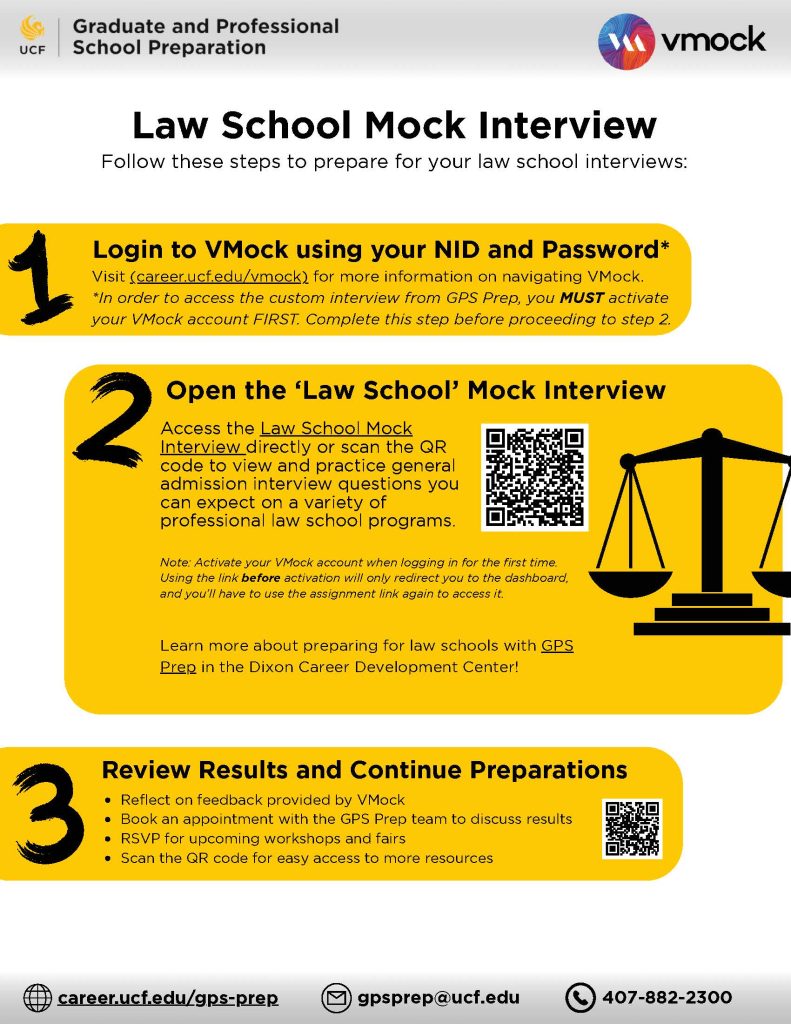
Our office proudly provides mock interview practice to help you build confidence and strengthen your communication skills. It is never too early to begin practicing the life‑long skill of talking about yourself and highlighting what you bring to the table. In fact, we encourage students to start practicing as early as possible! One great way to get started is by using VMock. Follow the directions below to log in and begin your practice.
Contact Us
Didn’t find the information you were looking for? Reach out to our office—we’re just a call or message away and ready to answer your questions.